

|
|
|
BACK TO SCHOOL So, before you go you-know-where, meet 16-year-old KATIE HENDERSON of England and check out the award-winning Reference/Research websites below! DWN: Most of us
readers do not live in the UK and when we hear "English schoolgirl" we
imagine someone wearing a tunic and a blazer, surrounded by dark wooden
hallways, and pinch-faced teachers. Is this an accurate picture of
you at school ...or is it just bizarre?
DWN: Are there any
online 'reference' websites which you use allot when doingyour schoolwork?
DWN: What is your
long-term goal [a.k.a. the 'what-do-you-want-to-be-when-you-grow-up' question]?
DWN: Recently, you
learned that those schoolmarm-types who are always lecturing people about
the importance of using the correct
typing posture, are right after all. What happened to you?
DWN: What do you
plan to do on Ataxia Awareness Day [September 25]?
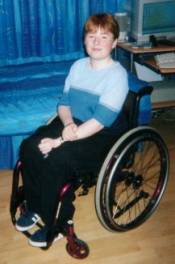 KATIE THE KUTIE! http://www.katesnook.co.uk/ Reference/Research Websites: Internet Public Library
-Online Texts Collection
http://www.camelotintl.com/world/ http://digital.library.upenn.edu/books/banned-books.html Mr. William Shakespeare
and the Internet
Bertrand Russell
http://www.geocities.com/Athens/Oracle/2528/russell.htm http://www.mkgandhi.org/ http://www.chem.ox.ac.uk/it/default.html Internet Public Library
-Online Serials
"Search the entire planet for the right college, including more than 700 in the United States..." http://www.allaboutcollege.com/ |
 |
|
|
||
Disability for me is not the end of life as I know it – it’s the start of a whole new ball game
BY HAYLEY CUTHBERTSON
“LIFE is like a ball game – I just play by a different set of rules.”
The sentence pretty much sums up 16-year-old Katie Henderson’s philosophy of life.
Just like scores of other teenagers across the county, Katie, of Runcorn Walk, Walsgrave, has faced weeks of anticipation as she waited to pick up her GCSE results.
On Thursday, the youngster was celebrating after gaining a clutch of A and B grades from Coundon Court School – a total of five GCSEs and one GNVQ – which she had worked hard for over the last two years along with her classmates at the school in Northbrook Road, Keresley.
Plans
And just like many of her friends, she has plans to go to college, to travel, and to be a “typical teenager, doing what typical teenagers do”.
What sets Katie apart from her peers is a genetic lottery which left her with a rare neurological disorder, affecting only one in 40,000 people.
The first symptoms were a general lack of co-ordination in her legs and hands; a tendency to fall over, spill drinks and walk much slower than other children.
She said: “I also wasn’t at all self-confident when it came to sport like my classmates – climbing ladders and walking planks seemed like mission impossible.”
After a series of tests, doctors diagnosed Friedreich’s Ataxia when Katie was eight years old. The disease has gradually progressed and Katie is now dependant on a wheelchair and uses a lap top to do her schoolwork.
Her mother Val said: “I was absolutely horrified. As a parent, to be told there is something wrong with your child is the worst thing you can ever deal with.”
But Katie’s own approach to her condition has helped the whole family, including dad Mike, triplet brothers Scott, Lee and Tony, aged 27, and sister Zoe, aged 30.
She said: “She always has a smile on her face – she has coped with so much and got on with life. She is wonderful.”
Katie, who is due to start an IT course at Tile Hill College in September, writes her own website, which combines a wealth of information on living with ataxia with a wicked sense of humour.
She says: “I have met so many other ataxians on the net and it is really helpful to talk to each other.
“I have also had messages from people who have been newly diagnosed and have written to thank me for showing them that you can be positive.
“If I can help other people like that, then that’s great”
Her one message to people trying to cope with ataxia is: “Disability is definitely not the end of the world. I love my life and do everything any other teenager does.”
Misconceptions
One of the things that bothers her most is that many people have misconceptions about ataxia sufferers.
She said: “People with ataxia might stumble about or slur their words a bit, and people assume they are drunk – they have even been picked up by the police.
“Raising awareness is an important factor of living with ataxia. It means those around me are more comfortable with my disability and will clear up such misunderstandings as thinking that ataxians are intellectually affected.”
Katie belongs to an internet-based support group called INTERNAF, which is holding an international awareness day on September 25.
She said: “If each member can inform their friends, neighbours and even their greengrocer about their disability then we will gain some of the understanding and exceptions that we thrive for.
“People should not make assumptions – I want people to see me rather than my disability and if I can achieve that just a little bit then I will be happy.”
Factfile
THERE are many different kinds of ataxia, caused by a rare neurological disorder. As yet there is no known cure or treatment.
ONLY about one in 40,000 babies are born with the genetic disorder. Some forms of the disease are inherited and can affect every child in the family.
INITIAL symptoms are usually clumsiness and loss of co-ordination, but as the disease progressed it affects mobility and speech and can lead to total dependency.
THE disease affects nerve cells which carry the movement signals between the central nervous system (the brain and spinal cord) and the rest of the body, resulting in ‘jumbled’ messages being sent.
THE gene which causes ataxia has now been identified, and there is now hope that one day scientists will be able to use this to prevent or treat the disease.
THE Friedreich’s Ataxia Group works with people affected by the disease, providing practical and emotional support to sufferers and their families, and raising money to fund research.
Quotes from Katie’s homepage
“I am ruthlessly down to earth about what I can and cannot do, but the truth is that disability doesn’t does not exclude you from many things at all if you have the patience and support to jump those barriers.
“Since I have been a wheelchair user I have abseiled, endured white water rafting, snowball fought with friends and partied the night away as teenagers tend to do.
“Disability for me is not the end of life as I know it, but the beginning of a whole new ball game.
“Attitude is everything. You have to make the best of whatever hand you’ve been dealt.”
Katie’s homepage can be found at www.katesnook.co.uk